
The Ghost I Live With
in memory of my grandmother Lela

I spent the 24th of April with my grandmother’s ghost. It was her birthdate, so it was no surprise, but what caught me off guard was how much I missed her. Is it that, at fifty-four, I am approaching the age she was when I remember her most clearly? Is it that I’m feeling the onset of old age and wondering how she navigated her own so well? Or is it that the older I get, the more of her I see in me? From the chaotic nest of cables on the floor next to my bed to the shawl I wear when the air feels chilly, more and more of Lela manifests in my life with each passing day and I love it.
I used to feel uncomfortable when some who had known her suggested I was like her, as she could be tough, pragmatic, even cold at times, and, as a child, I’d wanted to be more like her sister Roxanne, the romantic of the family. But then life began to happen in earnest, and nothing can guide us to a deeper, kinder understanding of others than the daily work of living and, perhaps most importantly, of growing older.
Lela was born in Cairo, in 1918, to Petros and Soula, Greeks who had settled in Egypt. She attended the Ursulines’ Catholic school in Cairo, and when she began to express an interest in becoming a nun, she was promptly taken out and sent to the British school. A very effective move, indeed, as she spent the rest of her life as an atheist, preferring the teachings of Betrand Russel to those of the church. Even on her deathbed, the real test of faith or lack of it, when a devout neighbour offered to bring a priest ‘just in case,’ Lela refused. It would be one of the countless incidents I would look back on when re-evaluating my opinion of her, of the woman I have come to see as nothing short of formidable.
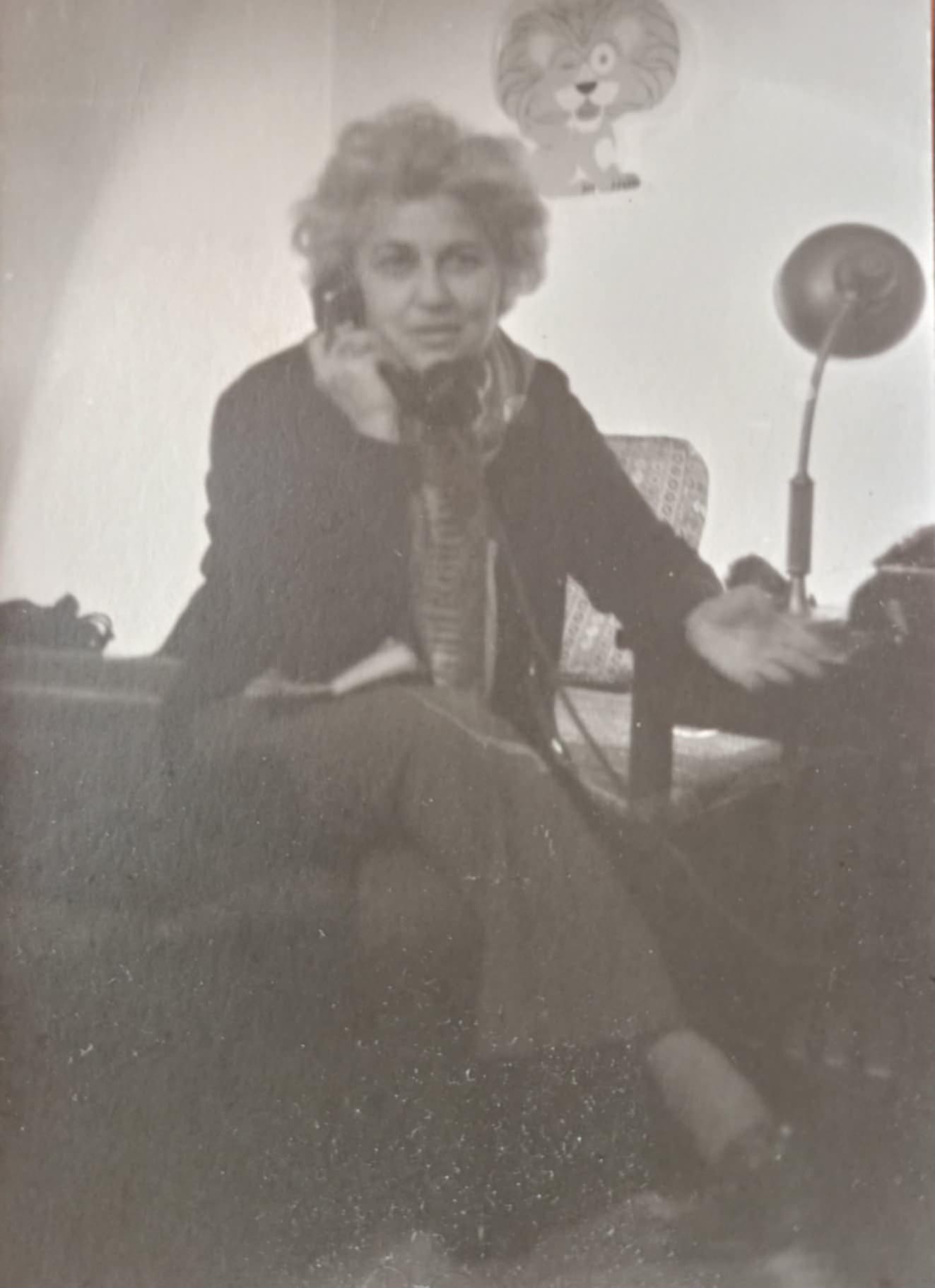
There were many sides to Lela, as there are to most of us, but there are two I think of more these days: Lela the grandmother and Lela the woman and how the two often combined in the most wonderful ways.
Lela the grandmother was fiercely dedicated. She believed few things in life were more important than culture, and, as in those pre-internet days in Greece any engagement with culture required effort, she would queue for hours to acquire tickets for performances of the Royal Ballet Company, the Bolshoi Ballet, obscure theatre companies from all over the world, operas. She would set off in the middle of the night sometimes, folding stool in hand, to ensure she was there when the ticket office opened in the morning. She would organize my sister and me for the long bus journeys to the theatre of Epidaurus, or had us stay with her overnight so we could set off early in the morning to see exhibitions of various painters and sculptors. If anyone ever suggested we were too young to understand what we were seeing, she would simply say that culture needed to be absorbed, experienced, before it was understood. This attitude of hers extended beyond culture. She never talked down to us and always took time to explain things to us, whether the matter concerned art, history, politics, or relationships. And this is where Lela the grandmother and Lela the woman meet.
She was married twice, both times to doctors. The first marriage lasted a short two years, as Lela, at that time the mother of a young son, my father, caught her husband, Christo, cheating on her. Even then, even at a time when divorce was frowned upon, when the life of a young single woman was complicated and challenging in ways I cannot even imagine, Lela refused to compromise her dignity and her independence and chose to walk away taking her young son with her. Her second marriage ended in tragedy when she was in her thirties, as her husband, George, a loving stepfather to my dad, died in a car crash, driving along the desert road from Alexandria to Cairo.
That was a Lela I only heard about, of course. The Lela I knew was unattached and had an endless string of boyfriends, a wonderful motley crew of various nationalities, ages, professions and temperaments. Did some of them overlap? Definitely. Did they know about it? Probably. She was a straight shooter and a hard worker, owning a bookshop and, later, a haberdashery, so had little time for lies, intrigue and drama. She also believed that children should be kept safe, but not shielded from real life, so my sister and I spent many a weekend and holiday with her and her various boyfriends, though only ever with one at a time. I don’t know how she managed it, but there was never anything uncomfortable or inappropriate about those encounters. Maybe she just made sure we met the nicest of the boyfriends, because my sister and I have the most wonderful memories of those times, from Tassos, who taught us how to play cards and took us to football games, to Dimitri, who recounted stories from his younger days as a rower in Cairo fending off angry geese with his oars on the banks of the Nile. She met her last boyfriend, Panos, a writer, at the age of seventy-five. Although almost twenty years younger than her, she had finally met someone who really saw her, who could love her just the way she was, and with whom she shared a love of theatre, of literature and music. When Panos died of cancer two years after they met, Lela announced to us all that she was finally done. There would no more boyfriends. She was seventy-seven.
When she too died of cancer a few years later, she did so with the independence, fortitude and dignity that had marked her life. After being informed that the cancer was incurable, she refused treatment and chose to spend her last few weeks at her own home. What I find most moving when I think of her last days is that even though she let my sister and I spend time with her and talked to us about her illness openly, there was that part of her that still wanted to protect us, even though we were adults. When I asked her two days before she died if she was afraid, she said ‘no, I’m not. I’ve lived a full life. It’s time.’ Only later did my mother tell me that that same day she had asked her to hold her hand and had said ‘Liz, I think I might be afraid of dying.’
Does knowing she was afraid change how I think of her? Does it make her less formidable? No, quite the opposite. Knowing there was a fragile side to her make the strength and resolve she showed throughout her life all the more incredible and inspiring. It has also added a tenderness to the love I already felt for her, to the way I carry her memory in my own life.
She is always with me. In the cables tangled next to my bedside table, in every book I read, at every performance or exhibition I attend. She is with me in my refusal to shrink or change to make others feel more comfortable and in the honesty I try to practise with my stepchildren. Ultimately, she is with me when I consider what I want my life to be as I get older, what kind of ‘older’ woman I want to be. It’s not about the boyfriends, though I’m sure she had lots of fun; it’s about the fierce independence it takes to live an unapologetic life.
Love this remembrance